All posts by therealsarahc

Don’t Call My Baby Fat

Look, I get it, all right? I have cute aggression, too. I can’t resist those chubby thighs, those chunky cheeks, the little Michelin tire rolls ‘round ankles, bellies, and wrists.  I mean, let’s just face it: skinny babies just aren’t as cute as the rollie-pollie kind.
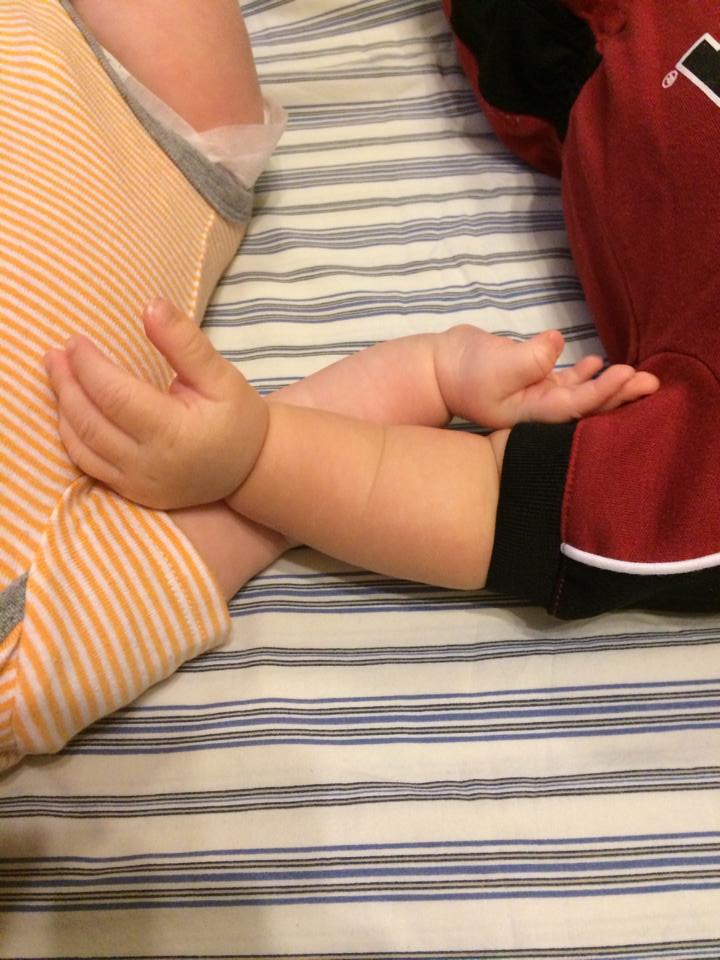
GAAAAHHHH!
GAAAAHHHH!

But so help me God, if one more person calls my baby a “chunky monkey”, or squeals with joy  while pinching her delicious little rolls between their forefinger and thumb, I’m going to lose it. God bless my girl friend who heard this from me recently after telling me she, “loved Moira’s chunk.” “Don’t call her that!” I said, a little snappily. My girl friend was chagrined, but listened kindly as I tried to dismantle my aversion and explain my reaction. Yes, Moira is chubby. She is rounded in all of the delightful ways a healthy young child should be. And unfortunately, I am a product of a society that equates “chubby” with “fat” and tells us that fat is just about the worst thing a person can be, so I’m a little sensitive to comments about my child’s looks. Until “fat” ceases to be synonymous with “lazy”, “unhealthy”, and “frumpy”; until “fat” is no longer antonymic with words like “beautiful”, “healthy”, and “attractive” — don’t call my baby fat. In fact, why not praise her for all other salient reasons for which she ought to be praised, rather than her looks? Her intelligence, her kindness, her joyfullness, her curiosity? Praise her being, not her body! But, that’s another blog post.


Before Moira was born, I made a pact with myself that she was going to grow up different than I did. That promise entailed a great many things, but chief among them were the lessons I learned about food, body image, and self-esteem. After I learned I was having a girl, I began to anticipate what an immense responsibility I would have in addition to being this child’s mother — I was going to be responsible for stewarding this perfect little girl through a world that would gladly strip her down to flesh and bones, both metaphorically and in body, to meet their idealized and unrealistic standards. I was going to have to fight for her right to be and do everything that made her heart feel right, damned what the world thought, because who is going to teach a girl how to be a healthy, happy woman, except her mother? Since she was born over 18 months ago, I’ve been increasingly defensive about my daughter’s body. It began with the acknowledgment of my own insecurities and a solemn promise to never share them with Moira. I can directly trace my own insecurities back to observations of my own mother, who would constantly poke, prod, and abuse herself for her plump physique. I recognize that if I don’t learn to put a cork in it (or, better, actually start loving myself), I’ll be hurting my daughter. As far back as I can remember, I was concerned about body image.  I distinctly recall being no more than seven years old (SEVEN!) and sucking my tummy in as I walked past boys in the supermarket because I wanted to seem appealing to them. But why? Where did I learn that behavior, those values? Yes, I was rounder, less lithe, than the other girls in my grade school, but I definitely wasn’t obese by any stretch of the imagination. So tell me how my self-image became so tarnished? My mother, I think, failed to realize how her example would affect me. Every time she talked down to herself, admired another woman’s thin athletic build while simultaneously degrading her own, I listened and incorporated her perspectives into my own world view. Every time she went on a crash diet, eschewing meals for “milkshakes” and killing herself on a Stairmaster for hours into the evening, I watched and I learned. When she would criticize herself in photos and compare her thighs to my grandmother’s while sighing mournfully, every time she took me with her to shop for clothes and berated herself in the dressing room, I logged it away for later use against myself.
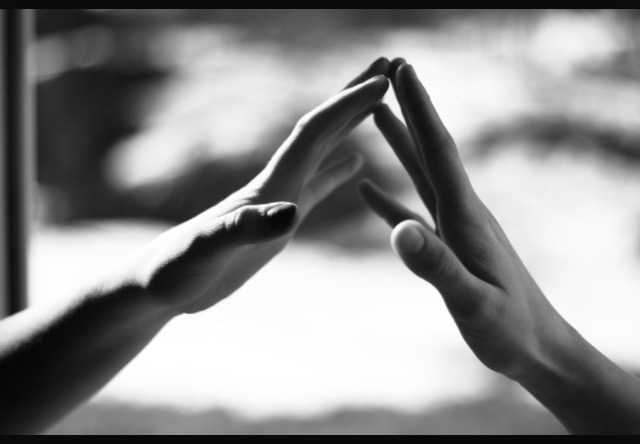
Mothers, you are your daughter’s first mirror. She will look at you and see herself. If you tell her that what she sees in that mirror is ugly, no amount of praise or compliments will prevent her from tearing herself down.
Mothers, you are your daughter’s first mirror. She will look at you and see herself. If you tell her that what she sees in that mirror is ugly, no amount of praise will reestablish her ability to love herself.

There are probably many more reasons for my low self-esteem and my lifetime struggles with weight. I wasn’t raised to be a healthy eater. I wasn’t raised to be especially active. I had a negative self-image from very early on, but as I got a little older and started to fill out in ways that weren’t considered healthy, I was subjected to a lot of criticism, both at home and at school. I don’t recall my pediatrician ever commenting that I was overweight, but I remember my parents scolding me for what I ate, and when, and how much. Our home was emotionally fraught and sometimes violent, and I began eating as a way to self-soothe. I would binge eat and hide it from my parents, and they would become effusively angry when they busted me (Tip: if your child is an emotional-eater, there are way better ways to confront that issue than shaming them about it. See “opposite of intended effect”.) Somehow, it never occurred to them to change their own habits in order to set an example for me to follow.  People aren’t born thinking that being fat is a bad thing — we have to be taught to hate ourselves or each other, and I definitely was. I was taught by two adults who didn’t much care for their own bodies how to hate my own. I don’t think they ever considered how their well-intentioned criticism, or their own self-hatred, would influence me. I’m a parent now, and I keep my mother and father’s example close to my heart. Not because I want to follow it, but because I want to avoid it. All of the wrong decisions my parents made, and all of the wrong decisions I later made for myself, I’m using those lessons to concentrate on making the right choices for M. Still, people allow their distorted perceptions of beauty and health standards color their view of our family and even our parenting choices. Yeah, I’m fat — does that mean that my daughter will be, too? No, of course not. I suspect that many people look at me and assume that a.) I’m unhealthy, lazy, irresponsible, etc., and b.) assume that I will graft my flaws on to my daughter. However, nothing could be farther from the truth: my husband and I make very careful, conscientious decisions regarding food and activity choices in order to set her up for life-long health. Note: health, not thinness, because we’ve got our priorities straight. Does she still eat pizza? Sometimes. (“My monkey, my circus”, remember?) You see, I don’t want to take all that I’ve learned about being healthy and run to the other end of the spectrum, counting calories and obsessing over what goes into our bodies. In the end, that attitude would defeat the purpose of what I’m trying to achieve: raising a healthy, intelligent girl who is able to appreciate all things are best in moderation. Regardless of the size of her dress or the number on the scale, she will know that she is beautiful, valuable, and important, even if she does keep her chunky-monkey rolls all the way into adulthood. Eff your beauty standards — those thunder thighs are a family legacy. And we are gorgeous.

Friendship Used to be Easy

Being a grown-up certainly complicates things that used to be simple. This week was National Best Friends Day, and I have spent a lot of time thinking about that magical word friend, and the romantic visions that it brings to mind. I have many different kinds of friends and I cherish them all. I’ve made friends with people who share my interests, people I met once and felt a connection to, even people who I have only ever met online. I’ve maintained friendships with people I have known since elementary school (God bless Facebook), and I consider my family tree to be supplemented greatly by the addition of those who I am closest to. My concept and practice of friendship, however, has changed a lot over the years.

I was a pretty friendly kid — a social butterfly, according to my second grade teacher. I remember being able to make friends with whatever group of children I was thrown in with. It didn’t have to be at school, either. It could have been a  playground, at Sunday school, or a family reunion. Kids are gifted that way. Any place where a bunch of kids are thrown together, you can see them form bonds of friendship almost instantaneously. It was natural. Effortless. If you shared the same interests, if played together well, that was all it took! We’d be friends for life!

Many of those friendships are temporary, though, lasting only as long as the gathering itself. If you saw that person regularly, the bond would could potentially be cemented. Looking back, I recognize that my across my lifetime, my Best Friend-ships tended to develop at the institution we shared and then shift when our circumstances changed: my elementary school BFF wasn’t my closest friend in middle school; my middle school BFF and I drifted apart in high school. My high school Best Friend is someone I still feel very close to, though we don’t talk very often. Even those other two girls — well, women, now — are still friends of mine. We’re not close as we used to be, but we’re friendly. Each of these three relationships were extremely hard-won — it takes work to remain friends after all this time, especially when you consider just how much a person changes between ages 5 and 25.

At the time, making friends with those women had been extremely easy. When I went away to college, I struggled in a way I hadn’t experienced before. I wasn’t making life-long friendships the way I had in primary school. Instead, I made many utilitarian pairings: friendships that served their purpose of camaraderie and lunch table companions only for as long as the semester lasted. It was depressing. I missed my real friends back in California, and I often wondered if I shouldn’t just give up and go home. Right around the time I started dating my now-husband, though, something coalesced, as if by magic. A group of like-minded, down-to-earth, plain ol’ good people was formed. We were a unit. Daily we took up two whole tables in the college cafeteria. We partied on weekends. We loved and supported one another like family. Those were the days.

These crazy people are my friends.

At my twentieth birthday party — the last I would spend with my mother — she looked around the table at my assembled friends and thanked them for loving me. She commented on how worried she had been when I moved to Hawaii for college, but became increasingly isolated. When she saw me with this group of friends, her worries were put to rest. When she later became very ill and knew that she was dying, she told me to count on those friends for strength. I believe it made her passing a little gentler, knowing she didn’t have to worry about my being left alone.

But shit happens. In the years following my mother’s death I was not an easy person to be around. Many of my relationships suffered or even withered away entirely as a result. Bridges were burned. I didn’t realize at the time that mental illness had become a factor in the equation, and I wasn’t taking care of myself. Some friends were easily dissuaded by my behavior and high-tailed it to safer grounds. Mistakes were made on both sides — I see that now. There were some friends that stuck it out and loved me even when I was almost entirely unlovable, and I was truly grateful. When I started to claw my way out of the darkness, I knew that these people would be in my life forever.

But then, again, shit happens.

You know what’s worse than a break-up? A best-friendship break-up. Man, that shit is ugly. I’ve lost friends before, but never have I been as wounded by the loss of a friend as I was when I broke up with my best friend. It wasn’t like we grew apart or anything — it was a series of wrong moves and then a major blow-out, and just like the end of a relationship, the end of our friendship was long, gritty, and painful. I felt betrayed and confused, especially when I heard from the grapevine that my friend had said things that were untrue and hurtful. I had loved her like a sister, invited her into my home, and gave to her without restraint. In the end, I got burned. The experience made me gun-shy of investing the time to develop new close friendships with other women.

Thank you for your application to be my friend. Unfortunately, we don’t have any available openings at this time.

The end result wasn’t that different from the aftermath of a relationship break up either. Like a boyfriend/girlfriend that says, “I don’t love you anymore, but let’s stay friends”, so did we for the sake of everything that we had once been to each other. It’s a stilted kind of friendship, one in name only. In terms of adult-like friendships, “friendship in name only” is one of the saddest and most common.

Still, I am very blessed in terms of friendship. Despite having misplaced my trust in the past, I now have an amazing network of friends, here-there-and-all-around, whom I consider family. I appreciate them more, I think, than the friends I had when I was younger. I have experienced enough loss and enough isolation to know how priceless these people are. Perhaps that’s the trade off.  As with many things, as children we took for granted that all life was good, believing as children do, that good must last. Grown-ups know that this isn’t true, but we also recognize that the things that you have worked to achieve have a heightened sense of value compared to those things you are just given.

Bottom line: friendship is important. Our mental health and longevity are both heavily affected by the number and quality of our friendships. The friendships we maintain as adults have enormous potential to become positive and life-fulfilling in a way that our youthful pursuits were not. As an adult, your friends take on the quality of family, particularly in a society that sees increasingly farther distances placed between close relations. In that instance, friendships take on a very vital function to provide us with all the same love and support that one’s blood relatives may not provide. These are the friendships that persist without consideration of time and distance — I don’t care if we spoke last five years or five minutes ago, you’re my family and I will love you forever. If you’re lucky, the friendships you formed when you were young will transcend to this level. If you’re really lucky, the friendships you forge as an adult will be cemented along these lines, too. How, you ask? I really can’t say. The planets have to align, the circumstances have to be just right, and even then, I think lot of it is luck.

Turns out friendship really is magic.

My Monkey, My Circus

She is my daughter. My charge and my responsibility. I get to make the calls, decide the treatment, and set the course of action. She is my monkey. This my my circus. And there are days that I haven’t the slightest clue how to conduct the show.

There are a lot of things that they don’t tell you about being a parent.

That there is just about the most common thing you hear, ironically. So common as to be a cliché. I mean, with all of the parenting books, websites, blogs, random strangers giving you advice, friends and family imparting parenting wisdom — how could there possibly remain something that they don’t tell you?

I think I know the answer: they don’t tell you because they don’t want it to be true. The truth of the matter being that parenting comes with a big, heaping dose of shame.

Shame for different reasons, though. Maybe because you didn’t breastfeed, or because you use those awful, eco-disaster disposable diapers. Shame because you do (or don’t) ascribe to a parenting philosophy, like “the gentle parenting method” or “the Montessori approach”. People will give you stink-eye for just about anything: how you make your child’s food, where you buy your child’s food, organic versus mass-produced versus vegan, home-care versus day-care, TV versus no TV, et cetera.

The worst shame, the most taboo, is the shame of wanting a break. That is most common, most stigmatized, and most under-rug-swept dirty little secret that parents can harbor. Sometimes we are simply and completely maxed out.

Doesn’t seem that the world has a great deal of compassion for us poor bastards. There’s no chapter in any parenting book that I have ever picked up that gives you tools for how to keep on keepin’ on when you’re just about ready to throw your hands up in the air, say “fuck it!”, and let the little bastard have their third cookie if it will just shut him up.. There are no online support group for parents to talk, openly and without censorship, about how they just don’t enjoy parenting some of the time. (Except maybe this one.)

No one warns you that some days, you won’t like your child very much, and that’s all right. Nah, we judge the hell out of parents who have the temerity to admit their feelings, saying things like, “Well, you were the one who chose to have them! It’s not the kid’s fault — she’s only a baby!” and “Didn’t you realize what you were getting into? Parenting isn’t easy, after all.” “What on earth are you bitching about? Isn’t not that hard.”

But the thing is that yes, it really is that hard. Even though I knew what I was signing up for, even though I even anticipated a colicky, unmanageable child much worse than the one I eventually got, there was no way I could possibly have been prepared enough. And while I understand that M is a small child who lacks the ability to control her actions, she is sometimes a tiny, tyrannical sociopath and the truth is, it gets to me.

I can’t help it. I love my daughter absolutely and completely. I have never, would never, consider a life without her. Being a mother has been a gift unlike any I have ever known. That being said, I would like very much to be able to take a short break from motherhood, in order to reacquaint myself with, well, my self.

There are things I used to do for myself that I simply haven’t the time or money to do anymore. Parenthood has robbed me of my ability to self-care. I can’t tell my daughter that her screaming is giving me an anxiety attack. I can’t explain to her that I have been feeling very depressed and low-energy, so I need to return to bed for a day. I never expected that my feelings could be hurt so swiftly by her capriciousness, that her coy refusal to give hugs and kisses would stir my feelings of inadequacy and low self-esteem.

I was prepared be tired. I knew there would be tantrums. But I never fully appreciated how sleeping in two days a week was integral to maintaining my sanity. I never understood how much I needed those quiet, isolated hours spent underneath the duvet in my darkened room. It didn’t occur to me that once I started caring for my daughter, seeing to her every need, that I would no longer be able to care for my own, or that my emotions could be so heavily influenced by hers.

It feels somewhat trite to muse over all the things I don’t like about being a parent. As I said, it’s an amazing gift, and one that I jealously anticipated. My husband and I are already planning Baby #2 (A second one! My god!) because we have always known we wanted to have a nuclear family. I am also acutely aware that there are many, many people unable to have the family that they dream of, which throws my words into rather harsh light. Still, it is my truth, and the unspoken truth of many: our love is boundless and unconditional, but our patience is not. The fact of the matter is that we are only human, and repeated trials by a demanding two-foot-tall bully will deplete our mental stores. It can’t be helped. Sometimes, the ringleader of the circus needs to leave the monkeys to their devices and exit the tent.

Of the Worldwide Rape Epidemic

My brilliant friend over at Caffffeinated makes no excuses and gives zero fucks: rape is epidemic in our society and it needs to stop. Join the conversation, stand up for what’s right, and keep moving forward.

caffffeinated's avatarcaffffeinated

I’m going to start by saying this is in no way going to be an all-inclusive commentary on the issues of rape. (It’s also not likely to be very well written, seeing as the subject makes me righteously and justifiably furious, which in my case can lead to incoherent writing.) I can almost guarantee I will be writing more about rape culture, abuse, etc. as it’s an important subject and effects everyone, worldwide.

However, I was prompted to write this piece specifically because of that last word. Worldwide.

A recent buzz about the rape rates and the feminist movement in India has emerged online. Women are dragging their attackers by the hair to the nearest police station, calling out the strange men slipping hands under their shirts on trains, addressing the 7.1% increase in rapes since 2010, supporting a new comic about a rape survivor and a goddess who…

View original post 635 more words

On the other side

It’s been a rough couple of weeks, mood-wise. Again, nothing in particular to blame except for my faulty brain chemistry. This is just another reminder that all of the work I do in therapy, the medicines I take, the personal development I devote myself to, is not always going to be enough to manage this disease. I sometimes get complacent in periods of mood stability where I think, this isn’t so bad. Then, without fail, I am surprised by the fallout, as if this hasn’t happened a hundred times before. As I’m bouncing between mania and depression, it can be really hard to keep my eye on something still, which is the most disorienting side-effect of bipolar disorder.

I’m pretty familiar with these ups and downs, but the preceding events to my most recent upheaval were new to me: I was in a very demanding interpreting situation and emotions were running high — not necessary in the assignment itself, but in me, because I wanted to do well. Ultimately, I think I did: I walked out of the assignment feeling that my team and I had faithfully represented and maintained the message, and that we were as unobtrusive as possible. Typically, I might suffer from a bit of nerves before or during an assignment, but it dissipates once I’ve the assignment is over (unless, of course, I mucked everything up while I was in the hot-seat, but that’s a whole ‘nother blog). On this day, however, I walked out of that assignment as jangly as a skeleton on a string. My whole consciousness pinged like a struck piano wire. The anxiety was so great, I didn’t know what to do with myself, and ultimately, I experienced something very akin to what I’ve read about sub-drop. With no where else to go, the adrenaline in my system caused wide-spread emotional and mental shut-down. I was so wiped-out, it was all I could do to just get into bed and throw a quilt over myself.

Of course, living in Hawaii makes this version of self-care a little sweaty.

Since that day, my mood and my energy level has been rather variable. I know it will get better, but I have to carefully tiptoe around that mental trap: “happiness is on the other side of this despair.” Because it really isn’t. Happiness is a thing you experience intermittently in the best of situations, and if you’re lucky, even in the midst of a depression. Happiness comes and goes just like everything else — it is not a destination, and no one has the right to 100% happiness one-hundred percent of the time.

So rather than try to convince myself that my happiness is waiting for me, if only I can push through and endure these difficult days, I am going to alter my narrative and focus on appreciating these days for what they are: a natural ebb and flow of positivity, unfortunately made more burdensome by my illness, and nothing more. If that means that I need to decompress by listening to Metallica at prohibitively high volumes after demanding assignments in order to burn up excess adrenaline before coming home to collapse into a cocoon of blankets, so be it. I empower you to do the same, and to be gentle with yourself — you are doing the best you can.

Black Sheep

A wise person whom I very much respect once said that writers should write what scares us. Right now, I’m terrified. Because I have never in my life done what I’m about to do.

Oh Lord, here we go...
Oh Lord, here we go…

Being the black sheep of the family, in and of itself, is not a big deal. Many people feel as if they have fallen far from the proverbial tree, but still feel loved and appreciated (even accepted) for their differences. Unless, of course, they are summarily and shamefully cast out.

Some, myself included, are deemed too subversive to be allowed a pass. In certain circles, there are some who are simply too different to escape scrutiny. They are so egregiously in conflict with their kin’s time honored traditions and values, that they are simply removed from the picture. Sometimes the cataclysm comes with a whisper rather than a roar. One day, you look around and realize that your roots have pruned themselves back and disappeared. Some are flung out more dramatically, of course.

The fear of abandonment robbed me of the courage to speak the truth about my family and how in efforts to appease them, I have capitulated time and time again to their tacit demands for obeisance and silence.

No more.

To be fair, they started it:

Seriously, look at this chucklefuck.

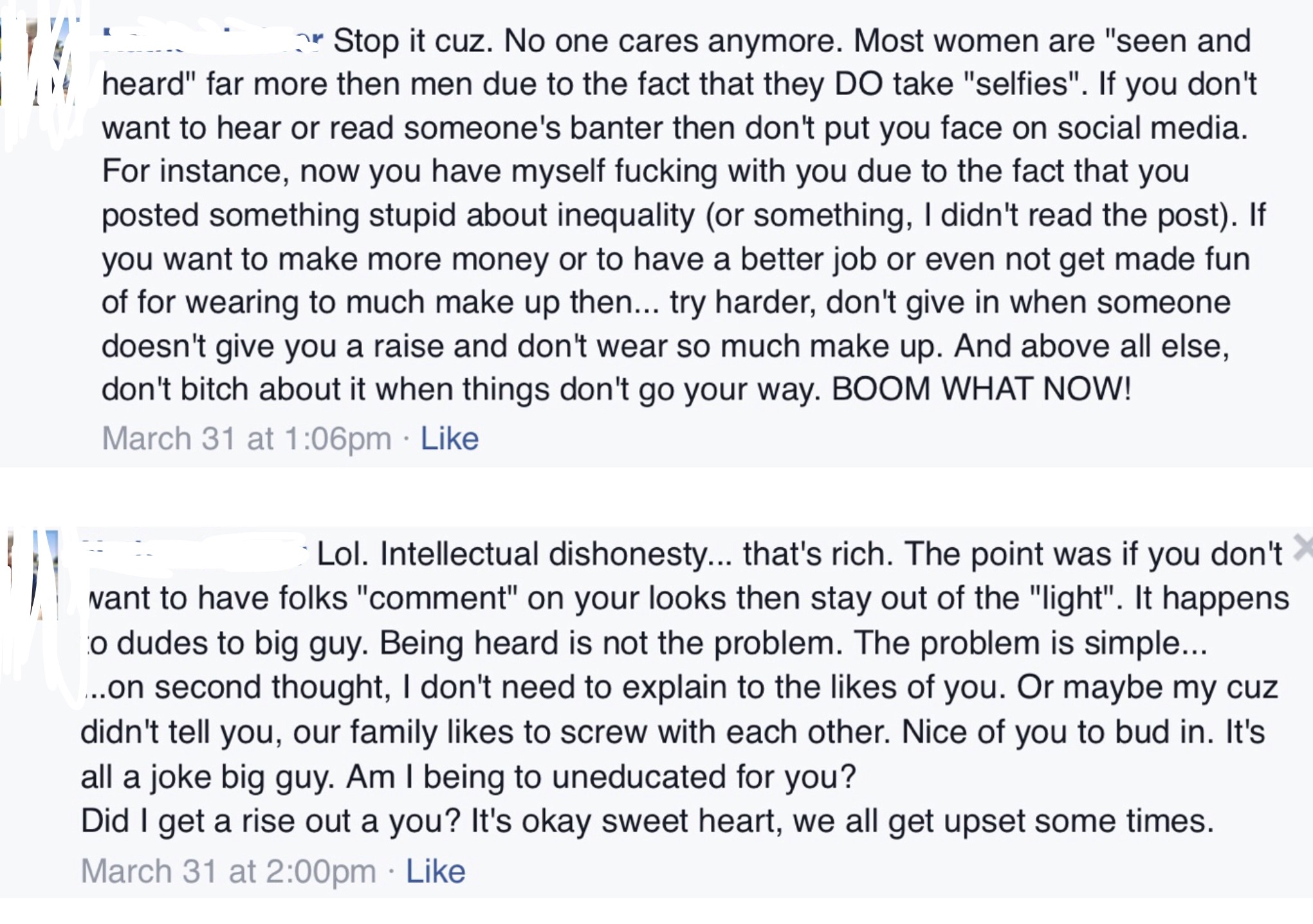
Okay, so let me give you a little background. I posted a link to this article on my Facebook page, and added a comment that I know women who have experienced this kind of treatment. In response, some member of my family — I will tell you only that he is male — felt it was his personal responsibility (nay, his duty!) to come around and knock me down a peg.

How far? How many pegs do I need to be knocked down before I am worthy of my family’s love and acceptance?

This time, I have opted to get good and mad, and thus I have been driven to a point of hatred and malice previously unknown to me.

First of all, me “stop it”? YOU STOP IT. Who the hell do you think you are to try and put me in my place? I don’t need to shrink and make myself smaller so you will feel bigger around me. I don’t need to compromise my ideals, my morals, just on the off chance that you might find my words offensive. And I do not have to dumb myself down, be less articulate, or think less just so I can fit in with this “family”.

Why put me down? Why seek with every word to belittle me? Why does making me feel small fulfill you? Yes, ours is a family that likes to fuck with each other. And fuck each other over. And fuck each other up. Ours is a legacy of hurt.

I reject the notion that to be intelligent, articulate, and well-educated is a sin. I refuse to align myself with your white-trash morality. Intelligent, free-thinking, even feminist are not swear words, except among simple-minded, misogynistic sheeple.

Baaaaaaa.
Baaaaaaa.

My soul is not for sale, and I’ve compromised for too long, allowing my affection and loyalty to be bought and sold like a commodity. In the interest of maintaining ties with individuals who will only love me on certain conditions, I’ve offered up everything. But still, I have lost.

I’m done.


I am no longer a disaffected youth, though I remain a product of my upbringing. As a result, I am chronically maladjusted.

I always knew that I didn’t fit in. I was never thin and athletic – I was bookish and articulate. And I was always tapped into something greater than myself, something that the people around me had no concept of. I have been perpetually aware of my separateness.

I don’t mean to be divisive: I love my family, but I’m not like them. I’m not sorry about that, though I used to be. I used to feel sad that I couldn’t be the same. I made choices that were engineered to try and make me blend, each with disastrous consequences.

Because when your cool, older cousin asks you to do drugs with him, ya do it. Duh.

I feel as if I have never been congratulated without being simultaneously mocked for having achieved anything in the first place. When I was a latch-key teenager out drinking, having sex, and stirring up mayhem, the family shrugged and wrote me off. One such matriarch attended my high school graduation after having offered the following sentiment on the occasion: “What’s the point? She’s just going to move in with that boyfriend of hers and get knocked up.”

I can't exactly accuse my family of having high expectations for me.
I can’t exactly accuse my family of having unrealistically high expectations for me.

But when I started to alter my course, rather than inspiring pride, each action I took seemed to cause anger and paranoia. I left California and moved to Hawaii to go to college — no, I “abandoned by family and moved to paradise.” Never mind the hardship that I faced once I was here. Never mind how hard I worked to succeed despite my circumstances. Never mind that I did everything “right”: went to college, met a nice man, got married, started a career, bought a house, had a baby, and all in that order. When it was all said and done, the sum of my achievements is tantamount to looking down my nose at anyone who didn’t achieve in the same way that I did. I’m the only person I know with such critically low self-esteem to have been so regularly accused of being arrogant, even narcissistic.

I think the primary motivation behind those accusations is the fear of my potential. The fear that, once I realized that I was better than the muck that I came from, I actually would condescend to them. That I would disappear and never come back.

This isn’t to say that my family didn’t celebrate my successes alongside of me. Simply that their inferiority complex dictated that in order to be proud of me, they must also remind me to be small: Don’t you forget where you came from! To which I respond: How could I? How could I forget when the legacy of this booze-soaked, drug-addled, emotionally retarded family hangs around my neck like an anchor? My achievements become cannon fodder and I a laughing stock, when I have done nothing — nothing — but try and mold myself into the kind of person that would be worthy of love and respect.

It has become resoundingly clear that I will never get to that point. And what I stand to gain from giving up the fight is so much greater than what I will lose from letting go.

I just want the freedom to be and to live the way that I see fit, without judgment or scorn. I’m exhausted by the accusations of arrogance and selfishness. I don’t think I’m better than anyone else based on my smarts or my success. But I will say this: I have more compassion, more love, and more understanding than was ever granted to me by that family, and for that reason alone, yes, I am better. Better than my origins, better than my history, and I am not ashamed to admit it.

I’m not sorry that I’m smart. That I maintain informed opinions. I’m not sorry that I kicked up the courage to dream up a different kind of life. That I went to school and toiled for six years to get three degrees. I’m not sorry that this cost me relationships with people who are supposed to love me unconditionally, but instead focus all of that energy on the fear of their own inferiority. If I must be excommunicated from the family for defying these values, I will accept my fate. I own everything that has ever happened to me, and if someone feels incriminated by my story-telling, they should have behaved better in the first place. And as far as I’m concerned, it’s your values that are corrupt. Not me.

So yeah, I’ll be the Black Sheep. I’ll wrap myself up in this thick, black wool. It’s so cozy and warm, I can hardly feel the cold shoulder you’ve been giving me.

But I'll be damned if I don't make this look good.
But I’ll be damned if I don’t make this look good.

BP D-Day

So it’s World Bipolar Day, and I guess that’s fabulous. I see lots of my friends and colleagues sharing photos of themselves with words strewn across: “I am a mother, a business women, and an avid reader. I am not my diagnosis.” It’s incredible to see so many empowered individuals owning their experience with mental illness and couching it in terms of “this is something I live with, but it is not who I am.

I really admire that. I’m just not sure I’m there yet.

Certainly, I agree that I am not my illness, but I struggle to cast it off merely as a condition of living, like the flu or a bad back. Bipolar disorder is part of my identity, and I don’t make apologies for that. I am who I am, in part, because of the personality quirks and general weirdness that BPD has imbued me with — and when I consider it objectively, I really like myself. It would then be a terrible hypocrisy to hate on my diagnosis.

That being said, it’s not always positive. It’s not always endearing to be a hermit. It’s not always funny to lose my temper at the drop of a hat. Sure, those things often make for fun stories after the fact, but day-to-day, I wear my illness like a shroud: it colors my vision of the world and marks up my skin. Literally.

IMG_3916It is an amazing triumph to say that I have been able to grow my fingernails out past the quick, even if my cuticles continue to be ragged. I am proud of the fact that despite (or perhaps because of?) my illness, I am able to devote myself to truly fulfilling work. Still, I am constantly aware that burn-out is a tangible possibility, and I often worry that I’ve taken on too much.

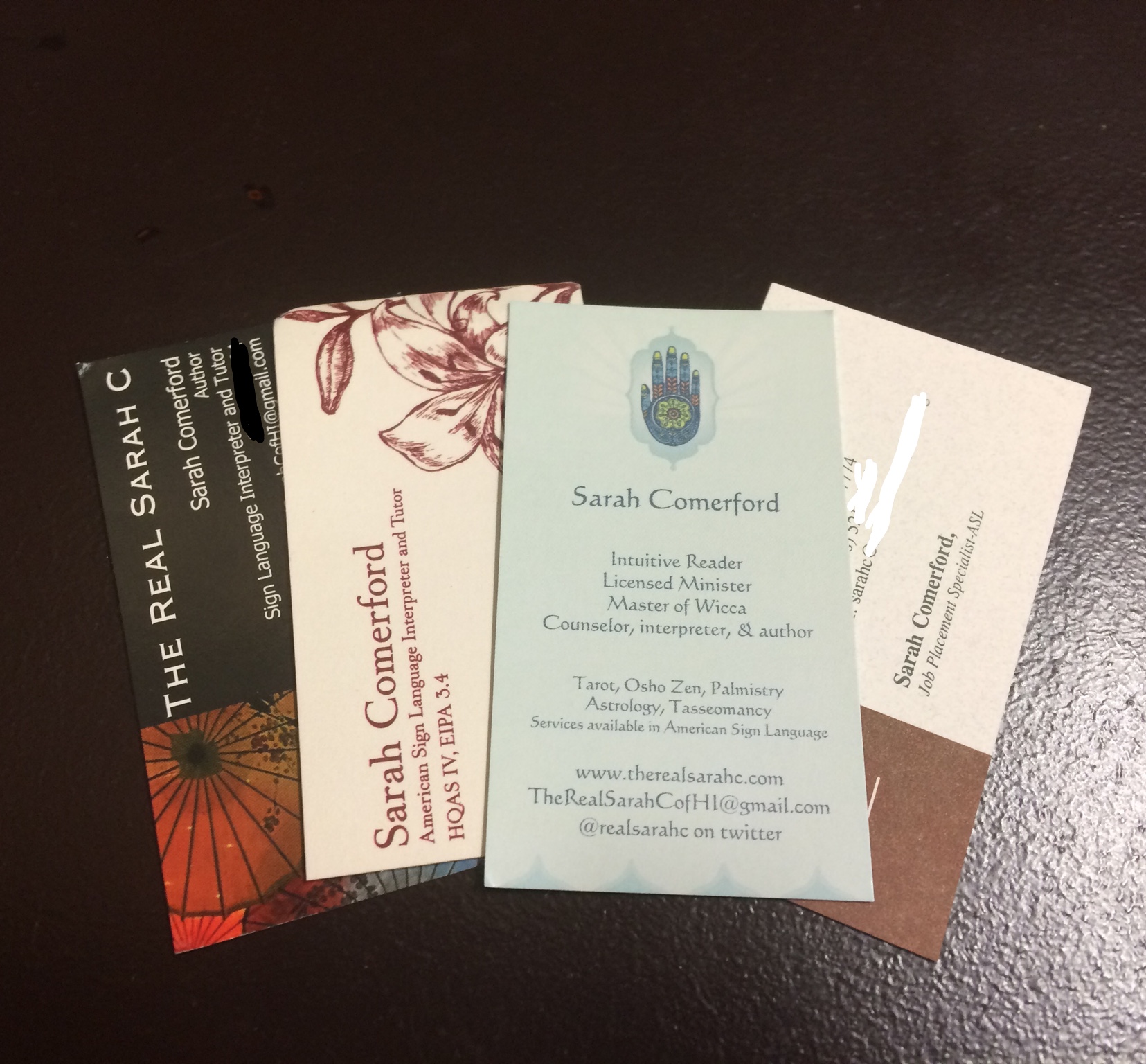
IMG_3919If I were to create an image similar to one of my friends, to express my success in spite of my illness, I guess that would be it. I mean, I have enough titles and talents to take up FOUR business cards! Goodness! But I feel that to do so would be disingenuous. I’m not who or what I am in spite of anything. I just am.

Perhaps I would feel better about #bipolarpride than “I am not my illness.” Bipolar is just a small part of who I am, and gosh darn it, people like me! (Myself included… most days.)

Some days

One year, my brother sent our mom a birthday card that really made her smile. It wasn’t one of those Hallmark deals with corny poetry and glitter — it was just a cheap little card. It had a photo on the front of a little boy sitting on the steps outside of his school, with his lunchbox beside him and his head on his lap, as if he were crying. Inside the card it said: “Some days, I still just want my mommy.” I think she loved it because she loved feeling wanted.

I think about that card a lot, particularly the sentiment printed inside: I just want my mommy. That thought wandered into my head the other night, as it often does, when I suddenly realized the date. March 8th. March 8th, the absolute worst day that ever was, ever.

In the seven years that have passed since she died, I have never gotten into the habit of honoring the anniversary of her death. March 8th is not the day I choose to remember her. It isn’t the same as those birthdays, Mother’s Day, or Christmas. Or any of the other happy occasions that bring her to mind and make me wish she were with us. The anniversary of her passing is a black mark, a day that got knocked off the calendar in sheer repulsion. A day too sad to commit to memory.

A pattern has emerged in the last few years. The anniversary goes by without my paying any mind — no more than usual, that is, because I think of her every day — but I don’t think about holding her hand in the hospital bed, listening through the night as she struggled for breath and the morphine slowly stole her life away. I elect to avoid that place whenever possible. It is as if I am walking down memory lane, the branches pulled aside to clear the path ahead. The coast is clear and then smack! One of the thin, springy branches snaps back and whips me in the face. I often feel guilty for having forgotten: I mean, here I am years later, still locked in a prison of grief. Should I not have kept count of all the awful days that have gone by and how many times I have needed her? I am forever affected by her death, but somehow, I sometimes forget that she died.

When the realization hits me, I count on my fingers — how long has it been? Seven years? Seven. Years. How it that possible? How I am still walking around with this hole in my gut, like the umbilicus that once tied me to her never healed? But then, maybe it didn’t. What is the shelf life of a mother-daughter relationship after the mother is dead and gone? At what point do I cease to be hers?

When shall I no longer wish to curl up beside her warm, soft body, my head in lap as she strokes my hair? When does a child no longer want or need their mother? I can’t fathom it, and I don’t want to. I don’t want to let go, because she was mine and I was hers and whatever wrong she did — and there were wrongs — and whatever I took for granted — and I did so, regretfully — she is mine. And I am hers: a mournful child crying on the front stoop, waiting for my mommy to pick me up and make me feel good again.

Separation Anxiety

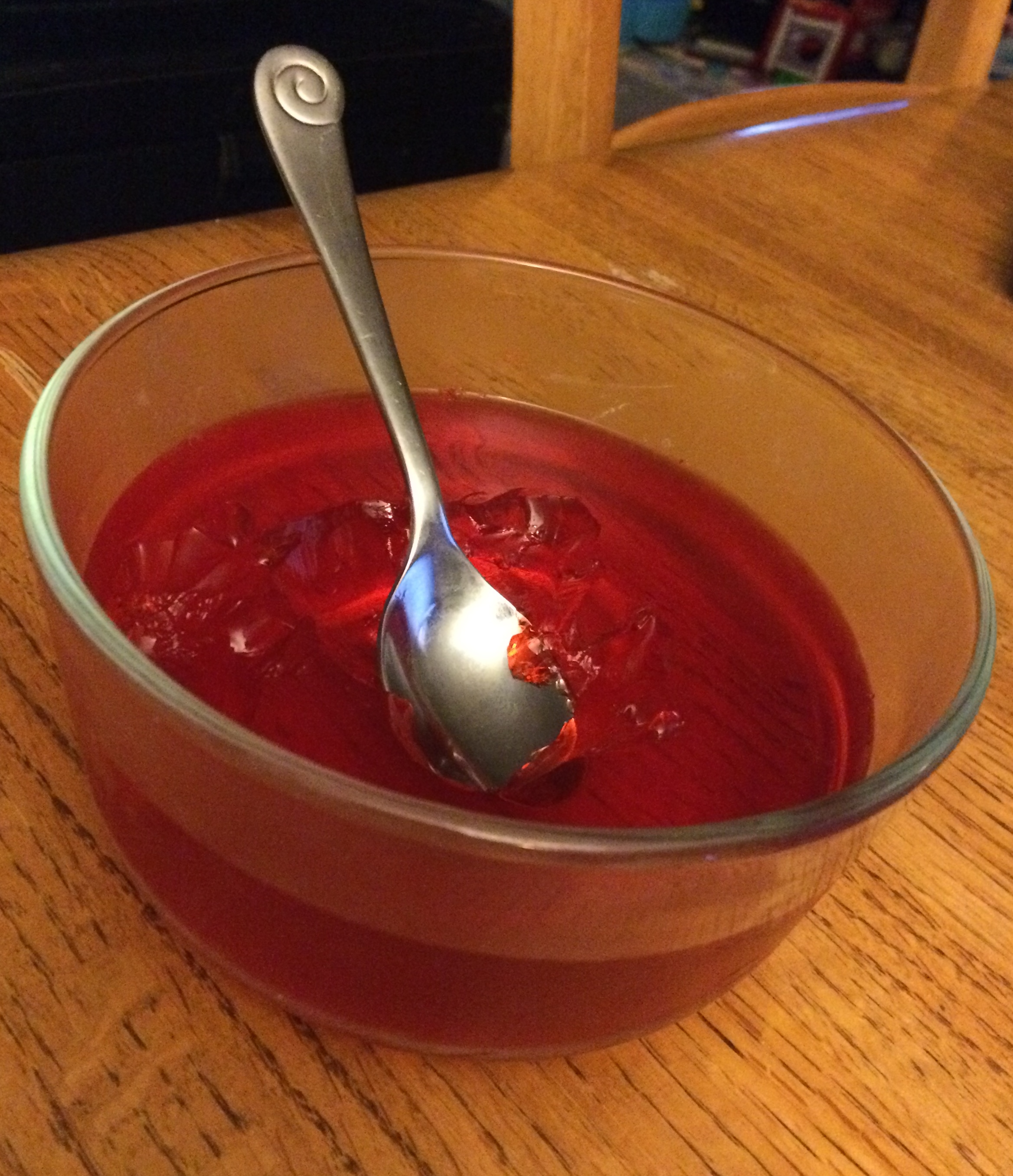
I have been blessed with a child who is flexible, pleasant, and joyful. She is also loud, opinionated, and relentless. So when Moira’s godmother and godfather offered to take her for the whole weekend to allow me some much-needed rest, I leapt at the chance, particularly when they offered to watch her over this weekend, as I have just had my last two wisdom teeth pulled and I fully intend to spend the next few days hopped-up on painkillers, eating Jello, and watching bad TV. Hey, you recover your way, and I’ll recover mine.

Jello: It's what's for dinner.
Jello: It’s what’s for dinner.

I’ve been looking forward to and dreading this weekend in equal measure. First of all, I’m not a real big fan of having teeth pulled. It’s painful and uncomfortable and it prevents me from eating solid food. On the other hand, SLEEP. I get to sleep in for two whole days in a row; a decadent, delightful vegetative treat. I’m really looking forward to indulging in that prolonged unconsciousness. On the other-other hand, though, I’m going to miss my baby. Since the day she was born and was whisked away to the NICU for the night, I’ve always been anxious when we are apart. So far, she has only ever spent isolated nights away at her grandparents’ houses and I have always rushed to pick her up the next day. When I’m home without her, I am at a complete loss as to what to do with myself. What do I do when I’m not acting as Mommy? While I’m anxious and troubled, however, Moira has proven to be as carefree and cheery as ever. I’ve never received a call in the night from a sleep-deprived Nani or Grampy with a screaming infant in the background. No desperate pleading for tips to get her to eat, or ways to decrease her crying — because she doesn’t cry. She is blissfully unperturbed. As always, my darling girl is too busy loving life to feel anything but elation.

Unbeknownst to me during my pregnancy, I had conceived the Anti-Sarah: a child so delightfully unlike me as to be persistently effervescent, filled with sunshine and happiness.

This has confirmed something that I have always secretly believed about becoming a parent: by some miracle, there are times when neurotic, emotional people have kids and witness these children turn out far better adjusted than the parents have any hope to be. Hallelujah! Honestly, I consider it a triumph: so far in my daughter’s 16 months of life, I have not managed to imbue her with any of my anxieties or neuroses. She doesn’t have any trouble sleeping over at her Auntie’s house because she is loved and secure. My daughter has no worries. Score ONE for Mommy! I’m not sure how long this will last, of course. Right now, she is fairly unaware of my struggles and idiosyncrasies, but that will not always be the case. I will have to continue to monitor myself and wage my personal war in private if I am to avoid exposing Moira to my various insecurities. I know from experience how important this is — I see in myself so many of the same feelings and manifestations of self-loathing that my own mother had. That is not the legacy I want Moira to grow into. My mission in life will be to preserve my little girl’s outlook (sunshine and rainbows included), so that the only one who has to suffer separation anxiety — or any other sadness — is me.

I put a spell on you

I am always trying to become more of who I am. That is, trying to make my outsides match my insides. Compartmentalization doesn’t really work for me — I just start feeling like I’m starving one area of life while barely sustaining the others. I’m a much happier person when I allow myself to live all aspects of myself simultaneously and without shame.

The aspect that has most frequently been pushed to the wayside is my spiritual side. My psychic side. I am a believer in the truest sense, but I have dabbled in my practice over the years, having surges of interest followed by valleys of inaction. I’m trying now to undo that pattern and integrate my beliefs into my daily life. To that end, following the classes I have taken with her, I have accepted an internship with Sarah Chamberlain to help mentor other Seekers and support the development of my own practice.

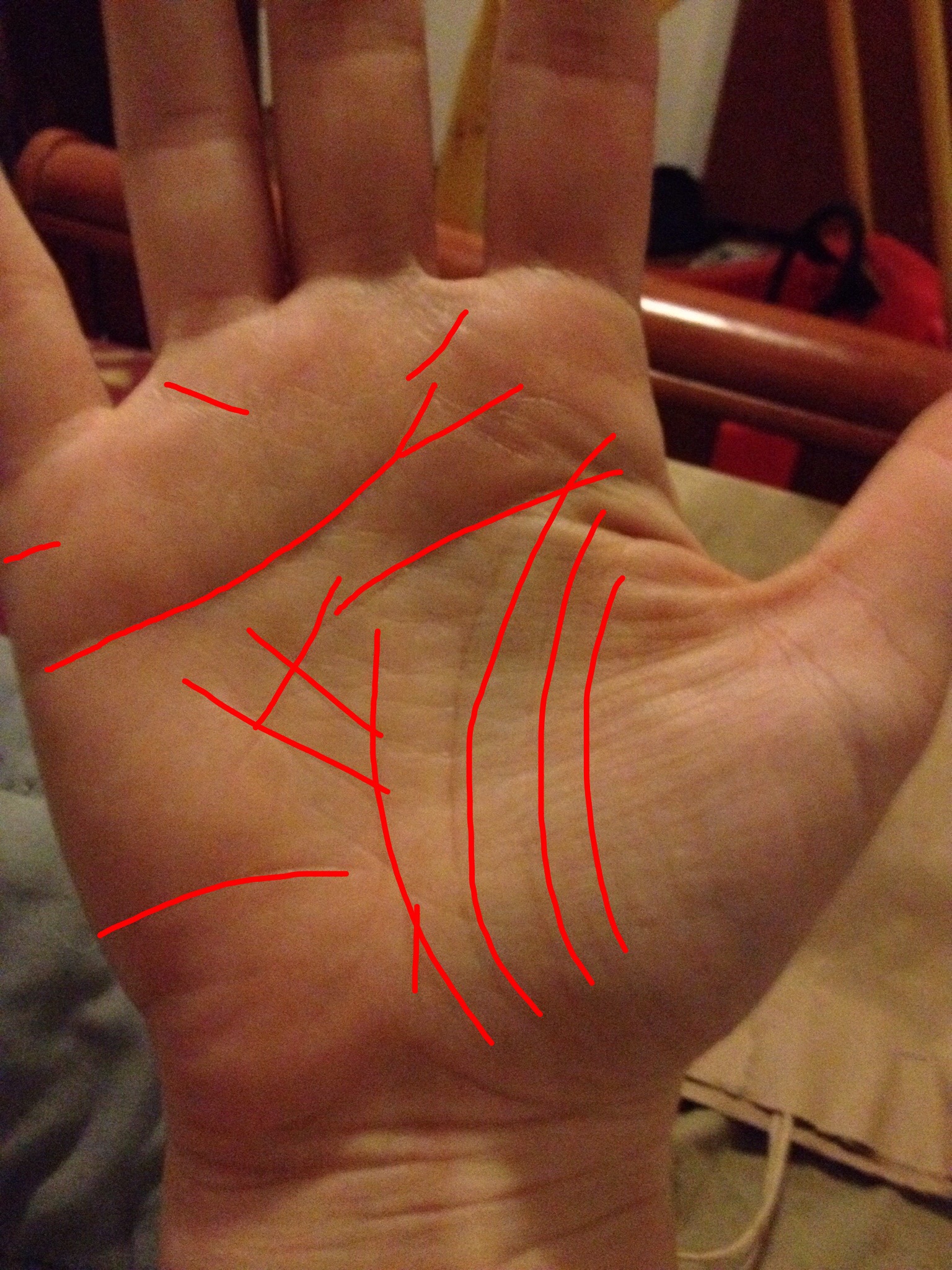
What will this mean?  I will attend Ms. Chamberlain’s classes as a mentor while continuing to learn from her example. So far she has already taught me to embrace my intuition and psychic gifts, read tea leaves, and I’ve increased my knowledge of Tarot and pendulum use. I also recently expanded my knowledge of palmistry. My repertoire is really growing!

imageimageimage


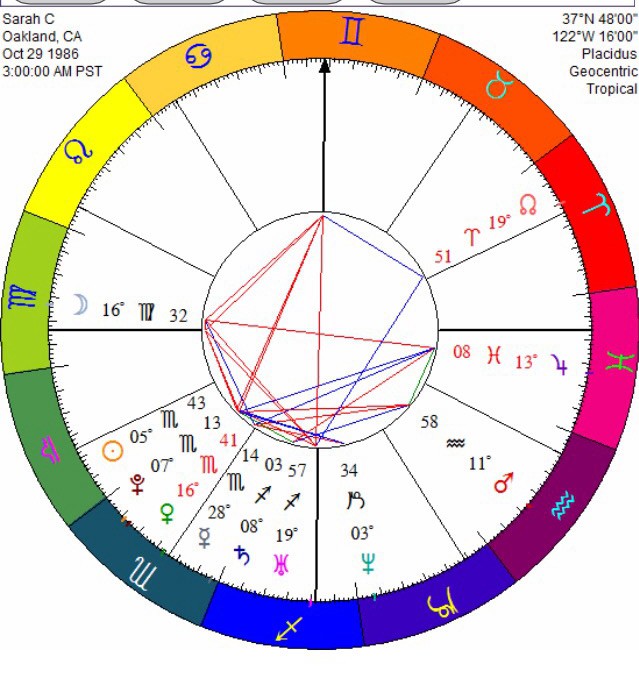
I’m also continuing to learn more about Astrology and how to create and read charts.

imageThe reason I’m writing about this on The Real Sarah C is two-fold: one, I’m really excited, and two, I’m quite nervous! I’ve done Tarot readings and palm readings for friends for many years, but always privately. I’ve never come out in public and introduced myself as a psychic — I’m still not comfortable with the term and it feels hokey to refer to myself in that way. But I recognize the power of self-identification as part of the pathway to self-actualization. Five years ago, I was similarly abashed to refer to myself as an interpreter, and I had to force myself to do it. Now, that’s what I do for a living and I couldn’t be more thrilled. So I’m going ahead and start calling myself a psychic — maybe not the kind you see in movies or on TV, but still a sensitive, intuitive individual, able to use the tools of the trade effectively and successfully. I am taking this step, announcing myself and my intentions to my friends and the Universe, in order to make my visions a reality. And I really am thrilled to find my life so full and so rewarding.

image