One of the biggest take-aways I ever received from my first interpreting mentor is that we are all, each and every one of us, a work in progress. We never stop learning, growing, developing, and becoming more of the people we are meant to be. For interpreters, this is a fairly common precept: in order to remain relevant in your field and to maintain your credential, you must earn continuing education credits in order to show a persistent commitment to professional development. In our personal lives, though, people tend to think that at a certain age who you are ought to be fossilized at a certain stage in development: your tastes, predilections, personality, mannerisms, et cetera shouldn’t change too much past an imaginary point in time. It’s true, to an extent, that some things tend to remain stable over time. My taste in music, for example, hasn’t been drastically altered in the last 15 years, though I’ve come to appreciate alternatives to my favorites. But what about our looks? At a certain age, if you deviate too much from what people have come to expect of you, you are branded a midlife crisis or said to be “going through a phase”. Change just freaks people out once we get beyond our formative years. But, honestly, shouldn’t all of our years be formative?
Case in point: my whole life, I’ve been more of a jeans-and-t-shirt kind of girl because it’s easy, if not fashionable. I’ve always liked make-up and looking pretty, but never enough to put a whole lot of effort into it. My idea of professional dress is “a nice top, and nice bottoms”. I don’t accessorize a whole hell of a lot because I can’t be bothered.
And then this happened.
In the last year, I’ve started getting into vintage fashions, hair, and make-up. I always enjoyed the look of the 1950’s pin-ups like Marilyn Monroe and Rita Hayworth, but it didn’t occur to me to try it until I was well into my 20s. This morning when I was getting ready for work, I looked down at my pencil skirt and monochromatic saddle shoes and thought, “Boy, I’m in full costume today.” But it isn’t a costume. Not really. Just because I’m altering my outsides doesn’t mean that I’m not doing it to match my insides — what my insides have been all along.
I don’t think we ever complete the process of becoming who we are, even when we are suffering ill-effects in that process. I recently began seeing a new therapist, and while going through my medical history and listing my various small-kine crazy behaviors on my fingers, I mentioned that it was only in 2012 that I was diagnosed as having bipolar disorder, likely as a result of untreated long-term depression and anxiety following my parents’ deaths. My new doctor said with a smile, “Ah, well, you just hadn’t fully bloomed yet.” I found that very profound. I like the idea that my endless struggle with mental illness is actually part of the process of becoming more of, not less than, myself. So many people think that their internal struggles — depression, anxiety, mania, self-harm, OCD, what have you — detract from their true self. I beg to differ: embracing and managing my illness is helping me achieve a new level of self-actualization that I hadn’t considered before. My pursuit of happiness, I realize, is a journey fraught with pitfalls and set-backs. The long and sometimes treacherous walk down that road has imbued my being with both good and bad, and has made me, Me.
I had to get pretty sick in the head, and come to terms with my ailment, before I could start really liking myself. How’s that for a kick in the pants?
Today is an appropriate occasion to turn to this discussion: April 16th is for the Semicolon Project, a social media movement for those that suffer from depression — who self harm, are suicidal, unhappy, have anxiety, or are living with grief — to embrace their story as on-going. Semicolons represent a sentence the author chose not to end. We are the authors and the sentences are our lives. My story doesn’t end here. I am a work in progress.
The concept of “home”, to me, is about family. And “family”, as far as I’m concerned, is about so much more than who your relatives are. Blood is not the only thing that makes a family. Marriages are direct evidence of this principle: even if you don’t intend to merge your genetic material to create offspring, when you get married, you form a new family. But even without government documents to bind us, families can be created in so many ways.
In our ever-expanding world, people very rarely continue to live within the same ten-mile radius that they were born into, often times moving thousands of miles away from where they were born and where their nuclear family unit resides. What then? We create our own homes, we find a new tribe, and we integrate into a new community. We set about adding branches to our family tree.
The people who surround us, care for us, and support us become our family through ties created of love. I’m very comfortable with the idea of an “extended” family. When I was growing up, it didn’t occur to me that my Auntie Rose and Auntie Nettie weren’t my mom’s real sisters — she loved them, so I did. They are part of my family. End of discussion. As a teenager, I began to wage my own life-long bonds of friendship and sisterhood. It was the first time I recall feeling bonded through shared experience: we are the same age, we come from similar dysfunctional backgrounds, we have similar interests. That was the foundation of our friendship. Then, just like Mary-Louise Parker’s character says in the movie “Boys on the Side”: there is something special that goes on between women. Through time and the magic of sisterhood, we became more than mere friends. We were sisters. Now they are my family. They are my blood. Period. End of discussion.
When I was 20, my mother died after slightly less than a year of fighting multiple myeloma. Just a year and a half earlier, we had lost my stepdad to lung cancer. I had moved from California, where both my relatives and my tribe did reside, to an itty bitty island in the middle of the Pacific in order to live with my mom and dad. And then they died. And I was alone in a way that one person should ever be. I had a roof over my head, but no home.
It took some time, but I crawled out of the crater left by that gargantuan life event. I finished college. I got married. I figured out who my real friends were and who would be members of my new tribe. I still felt like an orphan, but I managed to connect with a number of compassionate women who loved me like a daughter. I started to mend.
The thing about love, though, is that not all love is created equally. Don’t get me wrong: all love is good. But when you lose the love of a mother, no amount of love from friends or siblings or fathers is going to completely fill that empty cup. I felt, deep down to the very bottom of my soul, like a motherless wastrel in desperate need of some mothering. Every day that passed I felt more and more like an orphan, and all I wanted was my mommy.
I got my wish, after a time. In spades, you might say. And this is where I think Fate played her hand: if I hadn’t come to Hawaii, I wouldn’t have learned about Hanai family, and I would never have found mine. In Hawaiian, hanai means to adopt, to be close to, to nourish, to sustain. It was not an uncommon practice among Hawaiians newlyweds to practice the hanai custom by bestowing upon their parents their first born child to be raised by them. Children whose parents were unable to care for them were also given hanai parents, perhaps outside of their blood relations. It was seen as a blessing to the hanai parents, to be given the opportunity to care for and love a child that did not come from their union. The concept of family, or ohana, extended to all members of the society: we are all in this together, we who are bonded by blood or by love, it makes no difference. My hanai mom (really, I have more than one), like my sisters, has no qualms about our relationship. We’re family, with all the rights, privileges, and responsibilities therein. Period, end of discussion.
It’s funny to think: I had to wind up a million miles from home, in a place I never anticipated I would go, surrounded by people I didn’t even know ten years ago, in order to find my family. My home.
But the day that marks your absence is not the day I choose to honor your memory. I have worn the loss of you like a shroud, a heavy blanket to curl into on harsh, friendless days. Daily I attempt to commune with your spirit and resurrect your voice in my head — “Please Mommy, tell me what to do.” I miss you with a palpable need, one that starts in my toes and reaches up to my fingertips, reaching out for you. It triggered in me a irreversible reaction, a sweeping depression, an ebb and flow of mania and sadness. I have been lost in those tidal waters for years.
I remember you. I miss you. I am not alone. The loss of you means our cups will never quite be full — all love is not created equally when you’re aching for the love of someone who can’t or won’t love you the way you need to be loved. All the love in the world, good people that surround us and carry our will, cannot replace what was lost when we lost you.
We all know teething is a special hell that God sends parents to, like being sat in the corner for timeout. Now you just sit here and think about what you’ve done! We chose to have offspring, so now we must live with the consequences. Our four-month-old is just starting on this hellish roller-coaster, making her sleep patterns erratic at best and nonexistent at worst. Complicating things further is my rampant, currently untreated, insomnia. Once I’m up, I’m up — no number of sweet, fluffy Serta sheep is going to get me to go back down again. Lucky for me, I’m not in this alone. My hubby is pretty good about taking one for the team so I’m not always responsible for investigating each cry. But given the fact that we have both become incoherent zombies due to lack of sleep, we have been suffering a few lapses in communication. Case in point: The Swing.
A perk of being one of the last couples we know to jump on the baby bandwagon, we’ve benefited greatly from their shared knowledge and their hand-me-downs. One of the best things we’ve received so far is a Graco Glider. This sucker is a six-speed, vibrating, baby-soothing master machine with 10 lullaby choices and an attractive bucket seat. But like all things magical and legendary, when passed on to intrepid new adventurers it arrives with a warning: Use sparingly, lest your little angel become accustomed to sleeping while in motion, and never sleep without it ever again. But Lord help us, we have been weak! In weeping desperation after trying and failing to soothe Moira ourselves, we have slunk shamefully to the Swing, buckled her in, and collapsed back on to the bed in a heap. I know it’s wrong, but it feels so gooood.
I’ve known for a while now that we have to put the kibosh on slumbering in the Swing but then she started showing signs of teething, which included late-night restlessness and frequent waking. Now, we as parents have become dependent on the Swing for our own sleeping needs. Such was the case night before last, when I lost that internal argument with myself and after trying for an hour to get her to settle down, buckled her in to the Swing before crawling back to bed myself, thinking that her dad (who works nights, so goes to sleep and wakes up much later than me or the baby) would put her properly to bed when he came upstairs. Alas, that was not to be.
At 2am, when M woke for a feeding, she was still in the swing. I picked her up, nursed her, and while Will was still sleeping, put her into her co-sleeper beside me. Twenty minutes later, I was back asleep, only to be awoken by M’s fussing around 4am. I reached over and swatted at Will, “Babe, your turn.” He didn’t move. Using only what could be called “necessary force” to wake him from his mild, selective-hearing coma, I smacked him again. “Babe! Your. Turn.” And bless his little heart, he finally rose out of bed to tend to our girl. Pleased that I had managed to pass the buck without sufficiently activating my brain to cause sleeplessness, I started to drift back to sleep. Then I heard it: The Swing had turned on at the foot of the bed. M had been in the swing for a few hours when I first went to sleep at 10, and now she was going back in for the night. A red warning light went off in my mind: No. Swing, bad. Must. Rock. Baby. To sleep. But I’m a little inarticulate when sleep-walking, so I think I just managed to fling myself out of bed, snatch M from my drowsy spouse, and walk her to the nursery. After changing her diaper, giving her a pacifier, rocking in the glider and singing songs for an hour, she finally, blessedly, went back to sleep.
At this point, I was a little miffed that I had been the one to put her back to down — though I knew it was my own damn fault for being at first too tired to tell William I didn’t want her back in the swing that night, and second, too distracted to set up ground rules in the first place. But in the spirit of all people recently robbed of precious, precious REM sleep, I only had room in my brain to be pissed at the man for making me do it. I tucked M into her crib and walked down the darkened hallway back to our room. Glancing at the clock before I settled in, I saw that it was 4:55. My alarm was set to go off in little over half an hour. Whoo, whoo! chimed a voice in my head. Spousal Abuse Express, your train just pulled into the station. All aboard!
However, I did not throttle my now sleeping husband about the head and shoulders. I cried a little on the inside, so as not to disturb him (I’m so fucking sweet, it makes my teeth hurt, I thought.) and I went downstairs to make some coffee, where upon walking into the kitchen I was confronted with a mountain of dishes. Toot, toot! Last call! Deep, cleansing breaths, now Sarah.
It was a close thing, but you’ll be happy to know: He survived to live another day.
I’ve been in a real rut lately. The depths of which I haven’t experienced in at least a year, and the lengthening duration of which scares the pants off of me. It’s a real, genuine fear of mine that I’m getting worse, and while I’ve been riding that manic depression rollercoaster, I’ve also been struggling to find ways to talk about what I’m going through in a way that is interesting and meaningful. Typically, my inner dialogue goes like this:
Me: Hey, that would be good to write about… I could word it like this and… Meanie Me: No one gives a flying fuck about that. What makes you so special? There are literally thousands of other bloggers writing about the same thing, and they already have the audience captivated. Why would the audience want to shift and read your regurgitated nonsense? Me: … well, I guess you’re right. What about if I were to write something about this depression I’ve been sinking into, and the manic episodes I’ve been having? It might really help me to get some of those words out and… Meanie me: PUH-lease! How depressing. You want every entry on your blog to make people wanna slit their wrists? C’mon! Lighten up. Me: … ok. I guess I’ll just go lay on the sofa some more.
So, in between starting to write things and deciding not to write them, I: — ignored significant obligations pertaining to my personal finances — worked late — got into internet arguments — posted irrelevant things on Twitter — threw my friend a baby shower — sat on the sofa — played with my baby Well, that’s the round-up for this month. I think April will be the “fuck-off-Facebook-I’m-leaving-you-for-Twitter-where-people’s-negative-diatribes-are-limited-to-140-characters” month. It’ll be swell.
And now, to begin the “Stuff Sarah Does” portion of my blog:
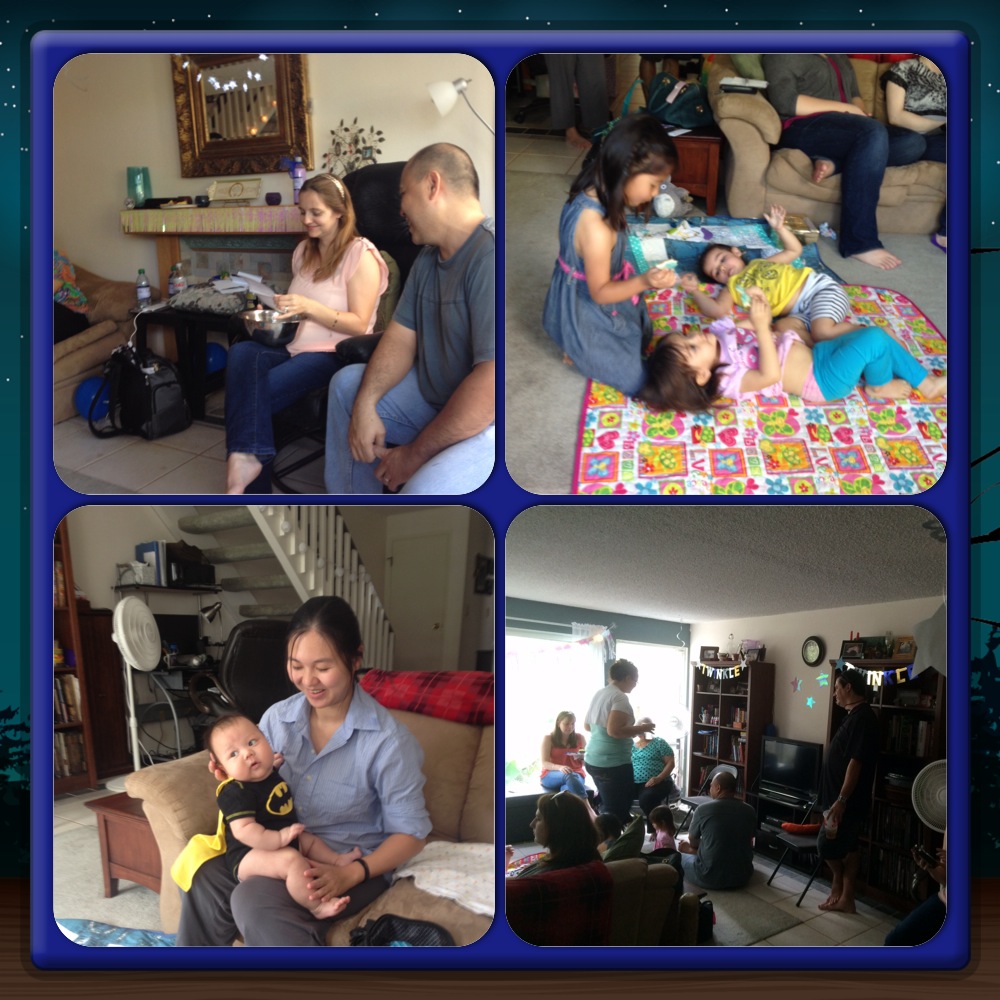
Mary’s Twinkle, Twinkle Baby Sprinkle
In honor of my good friend’s second daughter, due this Spring, we threw a shindig at my house. It’s the first time I’ve ever organized and hosted a shower or gathering that wasn’t entirely informal. I made things with my bare hands. All in all, I’m calling it a wild success.
We had your standard games and baby-shower activities, plus one that I invented to match the theme: “Name That Constellation”.
That bottle that you see there is one of those “patience glitter bottles” that have become so popular on Pinterest. God bless my fellow Pinners, by the way. Without their inspiration, I think this party would have been a little droll.
One of our activities for the adults and the kiddies alike: affirmation flags for Mary to have with her during her labor and delivery.
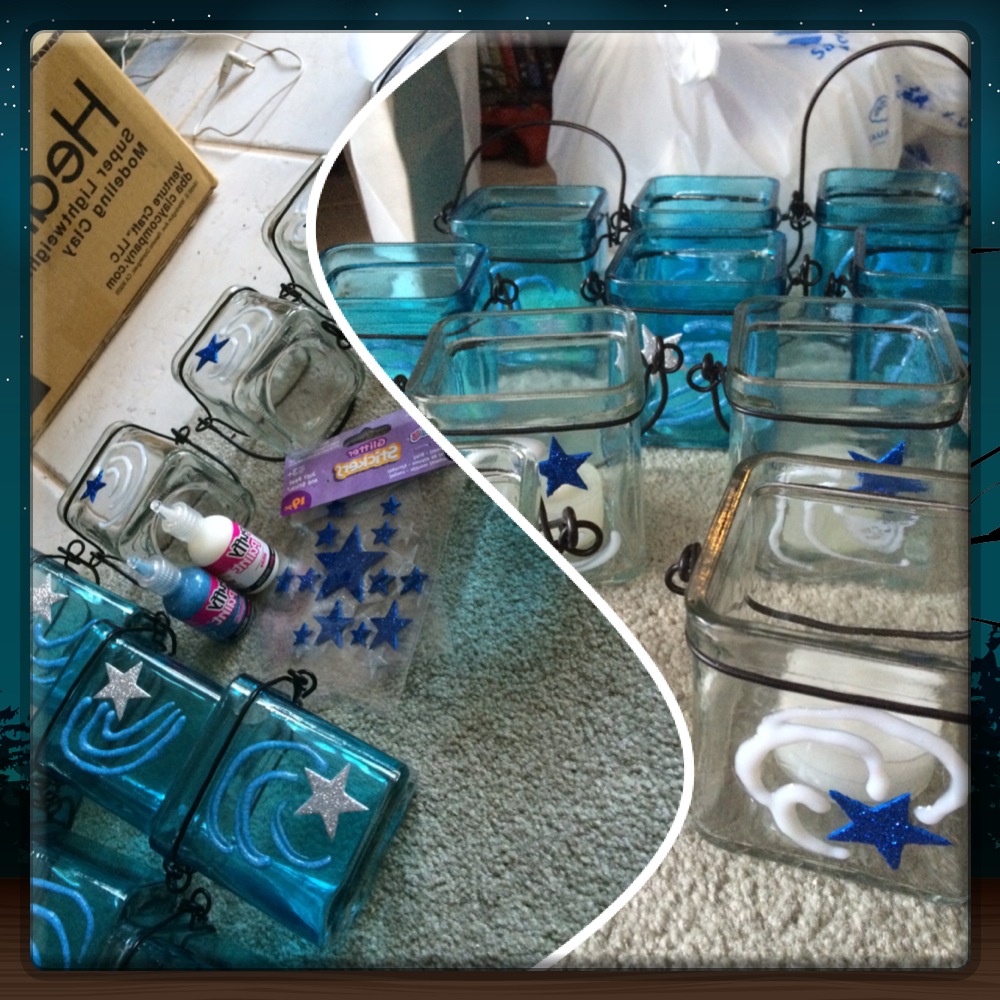
Hand-made nursery art and favors, care of yours truly.
I’m proud of what I was able to do for my friend, and grateful for all the help I had along the way to make her day special. I don’t think I’ll become a professional party planner any time soon, but on this occasion, it was rather fulfilling.
After taking a personal inventory, I have made the following observations of myself as a friend. I am:
A.) fiercely loyal,
B.) very good at social networking websites, and
C.) extremely unlikely to ever speak with you on the phone
Also, if I were to be perfectly honest with potential friends upon first meeting them, I would be absolutely friendless.
It would probably go something like this:
New Person: Hi, my name is ____.
Me: Oh, hello, _____. I’m terribly high-maintenance.
New Person: (walks away quickly from the crazy lady)
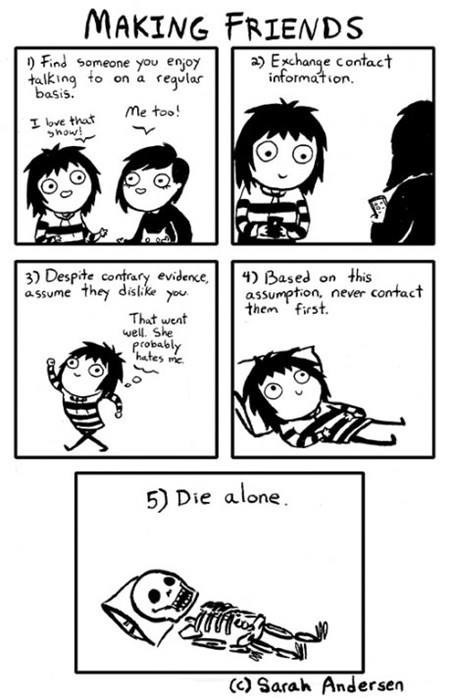
Conversely, if on occasion I managed NOT to frighten people away within the first five minutes of meeting them, it would ultimately lead to:
This is not conducive to long-term happiness.
Truthfully, I’m not high-maintenance in the worst sense: I don’t want to be surrounded by sycophants or anything. But I am pretty sensitive, and I have a lot of baggage and a lot of hang-ups, and, well, I can be a little crazy. Crazy = inconsistent = unpredictable, and generally speaking, people don’t find relationships with unpredictable people to be particularly effortless. And it comes down to the degree of effort involved, I think, that prevents my making significant connections with many people.
First, there is the problem of defining “effort”. I don’t need, nor do I especially want, my friends to call me on the phone for idle chit-chat. Talking on the phone makes my brain seize up and misfire. People complain that texting or writing emails leads to miscommunications because you cannot tell the affect of the person with whom you are conversing, but I beg to differ: slap some emoticons on that bitch, spice it up with affect cues in asterisks ( e.g. *sarcasm*, *rolling eyes*), whatever — it’s the talking on the phone and not being able to see your face that gets me all discombobulated. For whatever reason, in the absence of face-to-face contact, it’s easier for me to discern someone’s true voice from their writing than from their disembodied voice over the phone. So, effort, to me, is keeping in constant contact through the avenues that cause me the least anxiety. It is no surprise then that the friends with whom I am closest are those with a 50 word-per-minute minimum texting speed.
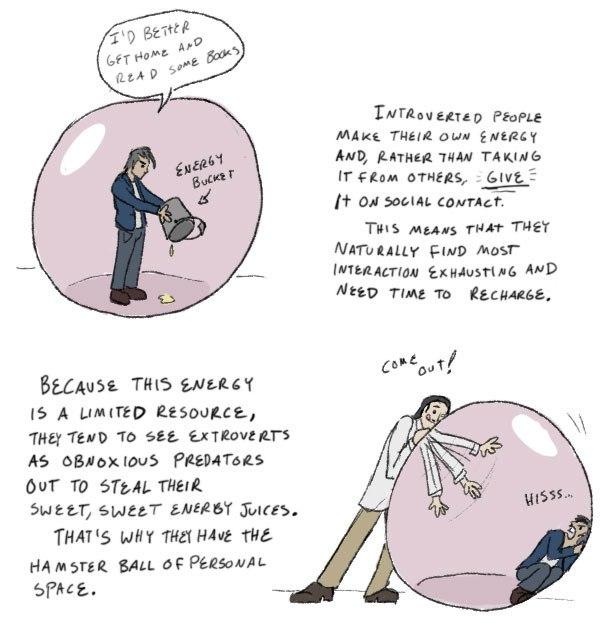
Second, there is the issue of how we will interface and spend time together. In keeping with just how much I hate to talk on the phone, I would much rather see you in person than anything else. But there’s another wrench in the works: I’m a goddamn introvert of the highest order.
But, I am also at the mercy of my moods, which will range from “Fuck yeah, let’s go DANCING.” to “You are welcome to sit beside me in silence while I sit in my quilted cocoon and watch a movie.” The very best friends that I’ve ever had are the ones who understand this and don’t hold it against me, while continuing to venture to bring me out of shell every now and again.
This is what a real friend looks like.
And finally, there’s the emotional crap. The Baggage. Jesus Christ, the baggage. It seems endless at times, the ways in which the emotional wounds inflicted during my youth can impact my present, and by extension, my future. It’s that ol’ ACOA thing again: We don’t know normal, we’re too hard on ourselves, we think love is a commodity that must be earned and traded, we take everything too seriously, we need constant approval and affirmation, we’re highly impulsive, and we have intimacy issues that strain the boundaries of reasonable. That is what I mean when I say that I’m high-maintenance. I don’t want to be that way — it goddamn sucks — but it’s hardwired into my brain.
It is for all of the above reasons I have come to really believe this quote from someone I really like and respect: “I have friends in spite of myself.”
I never intended to use this blog as a forum for my rants — and I really try to avoid doing so — but given how many of my neighbors and community members have recently spoken with me about the following, I’m going to ask readers to bear with me.
Recently, a Huffington Post article about the 18 Worst Things About Hawaii made the rounds on Facebook. The author made some good points, despite purportedly not being from Hawai’i himself. As it was, though, the article swept the newsfeeds of local people due to one simple fact: We are all so god-damn tired of being accused of living in “paradise”. And I’ll tell you why.
1. Yes, the scenery is beautiful (most of the time) but you will rarely, if ever, have the opportunity to really enjoy it. This is due to the fact that the cost of living in Hawai’i is nearly 50% higher than the average cost of living for the contiguous 48 states. The national average for a gallon of gas is $3.54 — I would kill to be paying so little, when an average trip to the pump will cost me $4.25 a gallon. Of course, gasoline is still cheaper than some food staples: a gallon of milk at Safeway runs between $4.50 and $5.60 a gallon, depending on whether it is on sale or not. This is the reason that you and your roommates/spouse/partner will be required to hold down two or more jobs just to afford the basics. Not a lot of time leftover for lounging at the beach when you’re working 80 hours a week (unless you live on the beach, which plenty of people end up having to do).
2. Don’t think that just because the cost of living is so much higher that your income will be commiserate.Poverty level guidelines from the Department of Health put the poverty threshold for a family of 4 in Hawai’i at $27,090 per year, which you might recognize as more than half of the average salary earned by American males. In fact, certain careers, like teachers for instance, earn LESS than the national average for the same position in another state (about $35,000 in Hawai’i, compared to $56,000 national average). No wonder there’s such a big push locally to raise minimum wage. And if, as many locals suggest you do, you give up and want to go back home, I hope you’ve been saving up for that eventuality this whole time. The cost of shipping your possessions back to the Mainland is likely more than what they are worth in total.
3. Every time there is inclement weather on the Mainland, you will be inundated with snide comments about how much better/easier/prettier your home island is. Seriously, you can’t so much as make a comment about needing to put on a sweater without some Mainlander questioning you derisively, “What, you think Hawai’i’s cold??” Yes, when it’s 59* outside and your house does not come equipped with windows that shut all way to prevent drafts, it’s fucking cold. Maybe not I-have-to-spend-an-hour-shoveling-the-walk cold, but still uncomfortable. Besides, it actually does snow in parts of Hawai’i. We even get nasty golfball-sized hail every now and again.
4. The traffic is soul-crushing — and I’m from California. Now, I get that LA now owns the illustrious distinction of having the nation’s worst traffic, but that was a recent development — Honolulu was number one on that list until 2013, with an average of 59 hours spent in traffic in 2012. But even if LA is worse, consider how much farther you get to go on the Mainland. Living on the continent, it’s not uncommon to work 20 miles away from where you live — a distance that is hardly achievable on O’ahu. So, the two hours you spend to drive 20 miles is not equivalent to the 2 hours I spend to drive 15. Sorry, it just isn’t.
5. This actually isn’t a very family-friendly place to live. With the median cost of a single family home nearly three times the national average and a nearly equivalent earning potential, it’s not likely that you’ll ever be a homeowner here. This is one of the reasons why multi-generational homesteads are so common. And as I’ve previously mentioned, the cost of living can be difficult to maintain, so it’s not likely that you’ll have the spare cash for a $700 plane ticket to fly back and visit your folks at home. And if you’re considering raising a family here, think about how Hawai’i’s schools are some of the lowest ranked in the nation, and a private school education will cost you $17,000 per child per year, minimum. So just to recap, you can’t afford to own a home, can’t afford to fly out to see your family, the schools are terrible, and you will end up living with your parents, children, brothers, sisters, aunties, uncles, grandma, grandpa — forever — because you can’t afford to live independently.
6. No matter what your skin color, somebody thinks you’re a fuckin’ haole. I’m really surprised this fact didn’t make it on to the Huffington Post article about the worst things about living in Hawai’i because this is a widely known truth — if you don’t look Local, get ready to rumble. Maybe this isn’t something people like to talk about, since we all like to believe that Hawaii is America’s melting pot, but truth be told, everyone’s a little bit racist out here. Sometimes, it’s a well-meaning kind of racism (if there is such a thing), like comedian Frank De Lima performing skits for school children that rely heavily on the racial stereotypes developed during Hawai’i’s plantation boom, when immigrant workers from over the world poured into the state to find work in the fields. We laugh when he sings a Filipino Christmas, and when he talks about the Portagees (my people) and Haole Anonymous. But most of the time the underlying racist attitudes carried by the born-and-bred locals harken back to the ancestral memory of Native Hawaiians being denied rights to their own land. The Hawaiian word “haole” actually means “foreigner,” though it’s most commonly applied to white people, because, let’s face it, it’s always the whities who show up thinking they own the place. This in turn translates in to a sort of running joke that really isn’t funny: “Oh no, I don’t go to the beaches out Ewa-side — I don’t wanna get beat up!” And given particular conditions, shit can get real ugly, real fast.
7. You will mostly likely be sick a good portion of the time, at least for the first few years (and then periodically forever after). The climate in Hawai’i is special, and by “special” I mean “stupid”. If you’ve ever suffered from an autumnal hayfever, be forewarned: pollination season for some native plants is year-round, and guava trees are especially pernicious to the allergy prone. Not to mention vog, the toxic mix of volcanic ash and noxious gases that drifts back over the East-most islands from the West in Kona wind weather. If you’ve ever had asthma, you’re in for a real treat. Especially since climate change is shortening the number of tradewinds that we have and increasing the number of Kona winds we get instead. I never had sinus problems in the 18 years that I lived in California, but after moving to Hawai’i, I need antibiotics at least twice a year.
8. You will get island fever and it will make a polar vortex sound like an adventure you’re willing to take. Granted, I’ve never lived in a place where I have had to shovel snow. If I had, I probably wouldn’t think it looks so pretty. But by that same token, you have never lived on an itty bitty island in the middle of the Pacific ocean that offers you just over a 20 mile radius to explore. No road trips, no weekend get-aways (unless you can drum up the cash to island hop), and a very limited number of things to do that aren’t outdoorsy — I mean, I like to hike and snorkel, but I could do with a little art and culture every now and then. Which leads me to my next point…
9. Make a list of your favorite things. Now tear it up, because you’ll never find them here. Your favorite bands will never come play here, and if they do, the show will probably cost you hundreds of dollars, if you can get tickets at all. Heard about a new art exhibit traveling the country? Yeah, Honolulu probably isn’t on the list (worse, if you live on a neighbor island). Or maybe you enjoy live televised sports? I hope you’re willing to watch that football game at 7:00am on a Sunday, because depending on daylight savings time (which we don’t have), Hawai’i is up to 6 hours behind the continental US. And the list just goes on and on: chain restaurants and department stores that you love have no local establishments, shipping costs severely limit the amount of things you have justify buying online, and new products released on the Mainland will take untold extra time to make it out here, if they come at all.
10. In large part, it’s like living in the middle of a giant tourist trap. Just like Vegas, San Francisco, New York, and other city destinations, Honolulu is crawling with tourists on the daily. But they don’t just stay in the city. They get in their rental cars and clog up streets all over the island, pulling over on the freeway to take photos of the Ko’olau Mountains and flooding all of the three major malls on island to find more tourist schlock they can bring back home. The majority of business establishments prefer to cater to the tourist industry, since it’s so profitable, which means insane mark-ups on products and services that you won’t see elsewhere.
11. You will be frequently assailed by the Paradisiacal Guilt Complex. Whether it’s your Mainland family and friends giving you a hard time when you complain about work because “at least you live in Hawai’i” or your own feelings of anxiety when you decide that you’ve had quite enough sun and just want to lay in bed all day, someone is always going to assume that since you live on a tropical island, there is a certain way you ought to spend your time (as if you could really afford to go to the beach everyday). You might even develop feeling of mild hatred for the beauty that surrounds you, because it seems to mock you every time you have a bad day: how dare you not recognize what a paradise you live in! You are blessed, damn it! BLESSED! Yes, well, it really is gorgeous, but I still have to work, I still have bills to pay, and I’m still wasting half my life in traffic. I don’t have the same right to bitch and moan as someone from Schenectady because my backdrop is prettier? I call bullshit.
So there you go. In addition to the things mentioned of HuffPo, another 11 reasons why living in Hawai’i kind of sucks. That being said, I know there are worse places to live. I guess my consolation prize for living on the verge of poverty forever is all the pretty rainbows I get to see and periodic whale watching.
When I was young, a terrible thing happened. The teeth of that event, jagged and complex as they are, shaped the contours of my personality in a number of ways (though I think it can be argued that I never stood a chance of escaping childhood without at least a few neuroses). Be that as it may, it was a short time after the deaths of my friends that my personality underwent a severe and startling shift. I can’t pinpoint exactly when it happened. I feel like I continued to be pretty normal in the first few months after their deaths. It wasn’t as if I didn’t receive counseling afterwards. My parents talked to me about what happened, and they took me to see a nice lady in a tidy little office who asked me questions about my friends while I drew them as stick-figure angels with bright yellow halos. That lady must’ve thought I was handling the trauma all right, because I only remember seeing her once. In the meantime, my dad took a few pieces of leftover fence posts and some primer paint to make a roughly hewn cross that he hammered into the grass outside of their deserted home. They took me to the funeral — closed casket — in a starchy plaid dress. I sat, not internalizing anything that was said, as I contemplated with horrifying clarity exactly why the caskets needed to be closed and large portraits of their young, smiling faces be displayed instead. My second grade teacher, Mrs. Steadler I think her name was, was especially compassionate in the wake of the event, inviting me to speak with the class or with her if ever I needed to.
All told, I think I adjusted with the same easy acceptance that all children employ when synthesizing a terrible event with their reality: It was bad, and it happened, and I’m sad that it happened. And then you move on because you’re a kid, and without sustained, repeated trauma, chances are the catastrophes you witness aren’t going to define your personality like they would in someone older. Such is the extraordinary capacity of children to heal and to love, so effortlessly.
But eventually something changed. In what now seems to be an overnight shift, I lost all feelings of safety and comfort. I was afraid. All. Of. The time. Like, can’t-sleep-with-the-lights-out, must-have-the-doors-and-windows-barred, TV-on-and-blaring-or-else-shit-your-pants-in-fear kind of afraid. I had night terrors in which my deceased friends would come to me and tell me that the afterlife was lonely and they wanted me to join them. In my dream, I would start to suffocate, then wake to find my face in a pillow.
Prior to this constant fear, I quite distinctly remember sleeping peacefully in my bedroom with the lights out, window open to the breeze, moon light streaming in. Then a change happened, wherein I became so utterly terrified of the darkness that I never opened my windows or blinds unless it was light out. I kept the overhead lamp on my bedroom’s ceiling fan blazing all night long, and if my parents tried to exchange the 100watt bulb for something dimmer, I’d throw a fit. Not knowing or not understanding why I needed to sleep with the TV on, my parents would remove the set from my room if I had done something to incur a punishment. This lead to some explosive tantrums during which I tried, with a child’s inadequate articulation, to explain why they just couldn’t take that away from me. It wasn’t about entertainment — it was about survival: bad things would happen if I were left alone in my bedroom overnight without the television on.
I would scream if left in the darkness. Maybe they thought that, if left to my own devices, I would tire and fall asleep, but the fear kept me quivering and awake. Once, my mother stood in my bedroom door silhouetted by the hallway light as I cried and begged her to comfort me. She answered, unequivocally, that she would not, because I was a big girl and I could sleep in my own room. The dreadful thought that I was disappointing her, that she was ashamed of my behavior, only made me cry harder.
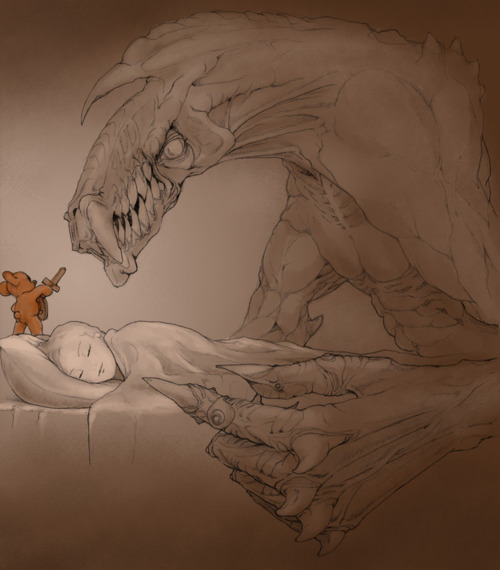
We weren’t a particularly religious family — we never went to church or anything like that — but I knew there was a God, that he had something to do with the gold cross my daddy wore and Santa Claus, and he could protect me if I played my cards right. This was the beginning of my ritualized behavior: I believed that if I said my prayers at night exactly the same way, in exactly the same order every single night with my hands clasped dutifully in front of my chest that God, like some combination of watch dog and genie, would keep me safe from whatever frightened me and also grant me wishes. If I forgot some line in my prayer speech (it was probably a few minutes long), I would have to stop and do it over again, because if I didn’t stick to the script, it wouldn’t work and any number of ghosts, goblins, or aliens would come attack me in the darkness. I went to one of those jewelry vending machines in the grocery store, stuck in my fifty cents, and got a cheap nickel-plated crucifix to put on my teddy bear. From then on I worshiped him like a fuzzy false idol, convinced that he was ordained BY GOD to protect me while I slept.
Like this, but more like a cleric instead of a knight.
I still have that teddy bear, by the way. His name is Joefas, and now he guards my daughter while she sleeps, sans religious armor of any kind.
Looking back, I think this was the period of time that planted the seeds of mental illness that I continue to struggle with today. The beginnings of my irrational anxiety. The genesis of obsessive-compulsive, ritualistic behavior. The foundation for my fear of abandonment. All of those threads can be traced back, not necessary to Cheri and Nick’s deaths, but to what I experienced directly afterwards. Due to my sieve-like memory, I can only speculate on what extenuating factors precipitated my descent into minor madness. My less-than-Leave-it-to-Beaver upbringing, some kind long-buried abuse, or perhaps, just the small, seemingly insignificant watermarks of everyday tragedy, built up over time. Were my irrational fears, my gruesome visions of dead friends, all symptomatic of some other long-forgotten trauma? I don’t know, and I don’t especially want to go digging for those answers. All I know is that while the Terrible Thing is one of the only things I remember, it isn’t the only thing that changed me. The rest, since it wasn’t reported on and can’t be searched on the internet, will just have to remain a mystery. Truthfully, I think I prefer it that way.
Memories are funny things. Inherently fallible, malleable, and extremely subject to influence, but even knowing this, we are convinced of their truth. Even those moments that seem to define us, to shape who we eventually become, are potentially corrupted. There are a great deal of things that I simply do not remember: not a single birthday party, Christmas, or happy schoolyard memory exists clearly in my mind. Instead, I have memories of photographs of these moments. My dad was an avid family photographer and I recall going through the credenza in the downstairs hallway and seeing pictures of the costume party we had for my birthday (Mom was a clown, Dad was a werewolf) or the Christmas when I was literally buried in gifts (imagine, 9 year old me grinning widely, a floating head emerging from an insane number of colored packages). But I don’t remember any of those events from the view of the camera behind my own eyes. They were happy times, and I’m grateful we had them. I wish I could remember those things instead of the awful times. The bad and the ugly.
Early this morning while my daughter was asleep, I found myself tripping down that manhole of memory. My mind was on my child, the absolute picture of beauty and all that is good in the world, and what would I do, how could I live, if anything were to happen to her? Bad things have been known to happen to children, regardless of how much love or care or protection their parents try to give them. There are very, very few vivid memories of my childhood that survived into my adulthood, and one of them is witnessing this dreadful truth first hand. Knowing how imperfect memories can be, I did something today that I’ve never done before: I took to Google to dig up some facts that might corroborate the film in my head. I searched, “1994 Antioch California Souza Murders” and there it was: “SOUZA V. THE CITY OF ANTIOCH, Plaintiff’s husband, Joel Souza, shot and killed their children on July 11, 1993…”
I had the year wrong. I had tried to calculate it based on my recollection: I always thought that I was seven years old the morning that I came downstairs to see swarms of policemen buzzing around my cul de sac. But in July of 1993, I was only 6. I was 6 years old when, on a lazy summer morning, I walked into a day that would fuck me up good, for many years to come. (Parenthetically, it should be noted that this is not to say that I am a victim of what occurred that day. I am so blessedly and completely removed from the horror of those deaths — it was not my children, my niece and nephew, my brother, my son, or any other family member that died. But they were my friends, and their deaths touched me.)
This is what I’ve retained: I came downstairs and saw from the front windows a flurry of activity quite unlike the average Sunday morning at Hunter Peak Court in Antioch, California. My mom and dad were reading the Sunday paper on the living room couch, and they didn’t seem to know about what was happening outside. I ran up to the window and spied my friend’s mom, Jennifer, standing on the sidewalk in front of our house. Two doors down, my friends Cheri and Nick lived with their mom and dad in the biggest house on the street. They had a great backyard — huge swing set. Even as a little kid, I didn’t have a lot of friends and Cheri was special to me. I was worried about seeing her mom, so clearly distraught, standing on the sidewalk outside my house with policemen and other neighbors milling about.
I asked my parents if I could run outside for the newspaper — you know, the one they were already reading. Once on my front porch, I strained to get a better look. Through the open door of their home, I could see police officers inside Cheri’s house. I went back inside and told my mom and dad that something was wrong.
After that, my memory gets hazy. Reading this lawsuit from the California Court of Appeal (trigger warning: reading that will severely depress you), I learn that the stand-off between Joel Souza, Cheri and Nick’s dad, and the police had been going on for many hours by the time I woke up that morning. I think I remember my mom going outside to speak with Jennifer. I think I remember a lot of the moms from my street gathering around her, trying to comfort her. I know that, at some point, my parents decided I had seen enough and barricaded me in their bedroom at the back of the house. They unplugged the television so I couldn’t watch the news coverage of what was unfolding just a few hundred yards from our home. They called my friend Ashley’s mom and asked her to come pick me up and keep me at their house for a while, but when she got to our street, it was closed off — the police weren’t letting anyone in. I think I was still in my parents bedroom when the shots rang out. I remember thinking it sounded like three firecrackers popping, one after another. I didn’t see the EMTs bring my friends out on stretchers, but I saw it later on the news. My dad said that, “they were still working on them” when they brought them out of the house. The FACTS section of the lawsuit does not corroborate this: it says that the SWAT team entered the bedroom where Joel had barricaded himself and his children to find all three of them shot dead.
It doesn’t matter, really. They still died.
Eventually, my parents were able to get me out of our neighborhood. That’s how I eventually managed to see news coverage of the event on TV: my parents had unplugged the set to prevent me from watching, but at my friend’s house, she had a set in her bedroom. I watched it there. I can still see in my mind’s eye the television screen that held the moving pictures of the worst day in my young life. But of course, memory is highly subject to influence. Who knows what I actually saw and what I imagined to have seen based on the adult conversations going on over my head, planting pictures in my mind that would eventually coalesce into memories. Either way, I knew then with childish certainty that it was a terrible thing that happened, and that it would shape me in ways that I still don’t entirely understand.





 The Real Sarah C.